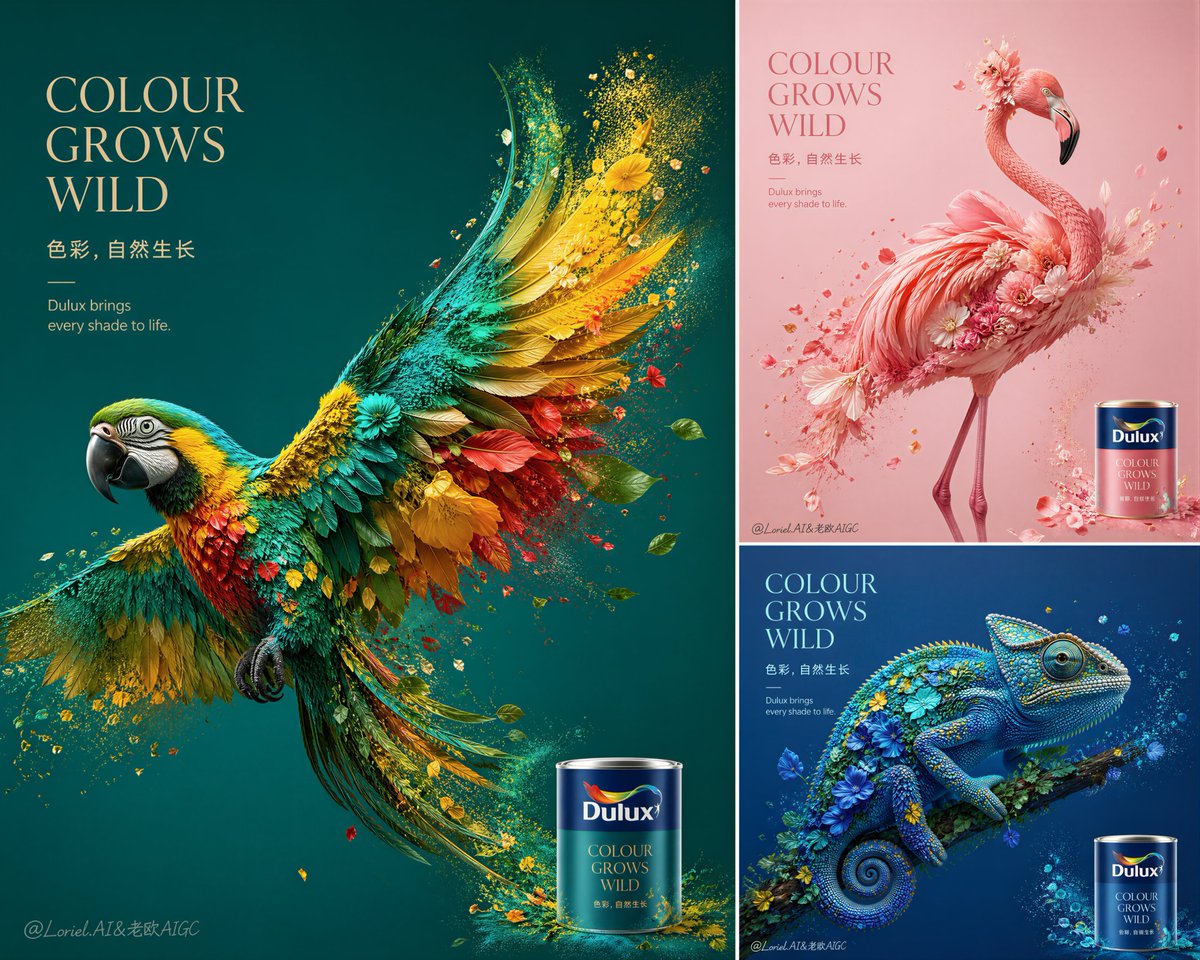
Create an ultra-premium three-panel advertising campaign for Dulux, designed as a cohesive triptych with a bold minimalist poster structure. Each panel should feature one hyper-real botanical creature: an animal whose body is seamlessly formed from a fusion of real anatomy, floral petals, leaves, delicate plant fibers, pigment dust, and refined paint particles. The campaign must feel visually striking, elegant, imaginative, and globally premium, with strong series consistency across all three panels while giving each creature its own dominant color identity.

Core concept:
The three-panel Dulux campaign should express the life-giving power of color through three different botanical-animal hybrids. Each creature must feel like a living embodiment of paint and nature combined, as if Dulux color has the power to grow into life itself. The key visual idea is that the animal is not merely decorated with floral elements, but organically generated through petals, foliage, organic textures, and color particles. The result should feel sophisticated, surprising, and highly artistic, like a world-class print campaign for a premium paint brand.

Series structure:
Design the campaign as a three-panel composition with one dominant hero panel on the left and two smaller vertically stacked supporting posters on the right. Keep the full system highly unified in layout, spacing, typography hierarchy, packshot placement, negative space, and visual language. Each panel should work as a standalone ad, but together they must feel like one premium Dulux campaign family.

Panel 1 hero creature:
A majestic macaw in flight, wings dramatically spread, but its feathers are partially formed from tropical petals, glossy leaves, fine plant fibers, and rich paint particles. The wing edges should dissolve into elegant pigment fragments and tiny botanical dust, creating a sense of vivid color and motion. Its color family should center on emerald green, vivid turquoise, sunflower yellow, and rich red accents.

Panel 2 supporting creature:
A graceful flamingo with a long elegant neck and refined posture, but its body and feathers are partially composed of soft blush petals, coral-toned leaves, delicate floral fibers, and drifting color particles. The silhouette must remain iconic and clean, while the botanical fusion adds softness and visual poetry. Its color family should center on blush pink, coral, peach, rose, and warm ivory.

Panel 3 supporting creature:
A poised chameleon with tactile realism, but its scales and tail transition into leaf veins, tiny moss textures, petal fragments, and precise pigment dots. The botanical integration should feel intricate and intelligent, with the curled tail and body pattern becoming a natural canvas for the fusion of color and plant structure. Its color family should center on cobalt blue, indigo, teal, deep green, and subtle golden accents.

Botanical fusion logic:
The fusion between animal and plant must be seamless and premium. Petals should feel like natural feather extensions, leaves should echo body rhythm, moss and leaf veins should integrate into surface texture, and fine pigment particles should behave like paint-born life energy. Avoid collage-like assembly. Each creature must feel biologically believable within a surreal premium advertising world.

Particle and paint logic:
Use refined paint-particle dispersion and pigment-dust transformation throughout all three panels. The creature edges should dissolve into elegant clouds of micro color fragments, tiny paint droplets, botanical dust, and soft petal debris. The transformation should feel controlled, beautiful, and luxurious, never chaotic or explosive.

Background:
Use pure-color minimal backgrounds for each panel, with one clean dominant backdrop tone per poster. Keep the backgrounds spacious, elegant, and softly refined, with no clutter or environmental storytelling. The background color of each poster should support the creature's main palette while preserving overall campaign unity.

Product integration:
Include a hyper-real Dulux paint can or bucket as a restrained lower-corner packshot in each panel, with clear logo visibility and consistent placement. The packshot should feel supportive and premium, never competing with the creature. The pigment or paint-particle trail may subtly connect the creature back toward the product to reinforce the Dulux narrative.

Typography:
Use elegant premium English-led advertising typography with a refined Chinese subtitle system. Keep the typography minimal and beautifully spaced.
Suggested text direction:
Main English title:
"COLOUR GROWS WILD"
or
"WHERE COLOUR COMES ALIVE"
Chinese subtitle:
"色彩,自然生长"
or
"让色彩长出生命"
Supporting English copy:
"Dulux brings every shade to life."
Typography should feel editorial, artistic, and globally branded, with consistent placement across the three posters.

Brand coding:
Preserve Dulux identity through:
premium product visibility,
confident color storytelling,
minimal international advertising polish,
and intelligent transformation between paint and life.
The full triptych must feel like one unified luxury campaign.

Lighting:
Use refined studio lighting with soft but precise highlights across petals, leaves, fur, feathers, scales, paint particles, and product packshots. The creatures must feel tactile and highly real, while the botanical elements remain luminous, delicate, and premium. Lighting should be clean, controlled, and elegant.

Mood:
fresh, premium, artistic, imaginative, elegant, vibrant, refined, intelligent, playful, botanical, globally branded, collectible

Rendering style:
hyper-real Dulux advertising campaign, three-panel triptych poster design, botanical animal hybrids, petals and leaves fused with real anatomy, refined color-particle transformation, pure-color minimal backgrounds, luxury editorial typography, premium paint packshot, world-class commercial image quality, 8k

Negative prompt:
cartoon animals, collage look, messy floral explosion, cluttered background, low-detail feathers or fur, weak Dulux branding, childish fantasy design, rough typography, random particles, cheap color effect, low-end poster composition